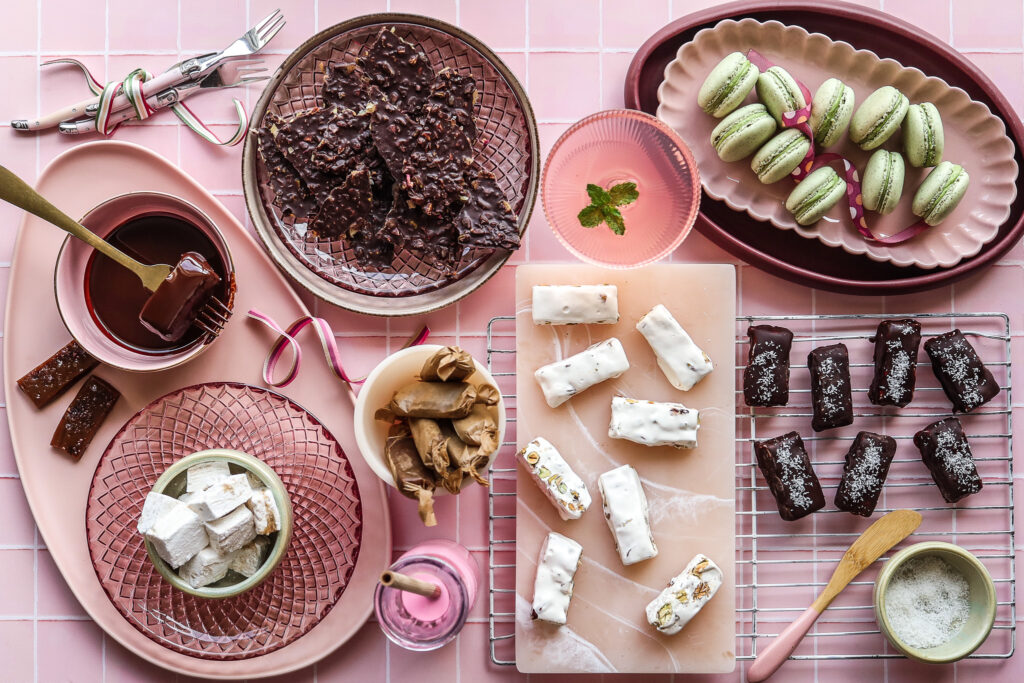
There is something about those long glass displays full of elaborate confections that makes us all swoon. Tray after tray of petit fours, morsels of fudge, or tempting squares of colourful nougat; combined with a steaming cup of café au chocolat, it doesn’t get much better than that! Each of those intriguing bite-sized dainties holds a surprise, a burst of sweetness, a delicate touch of the exotic. To watch a professional confectioner ply his trade with confident hands is truly to witness magic. He can drizzle the perfect coating of chocolate, pull the taffy in just the right direction, or bang the pan of fragile macarons at precisely the right time. It can truly inspire awe in those of us who consider it an accomplishment to make a cake from a boxed mix!
If we could go back in time just a few centuries, we may not have recognised what were then considered the extravagant sweets of those days. The Ancient Egyptians enjoyed fruits and nuts sweetened with honey, and these were rightly viewed as highly nutritional.
The early inhabitants of Rome had to go to the Spezieria, or medicinal dispensary, to obtain any sweets. Sugar was highly regarded for its “healing” properties and confined to curative mixtures concocted by the apothecaries. There was no doubt that various forms of sugar gave energy to the weak, and in those times, it was considered a healthy medicine. If this were truly the case, we would now be the healthiest populace in history!
The Middle Ages gave rise to the confectioner, an admired city-dweller, that created sweetmeats and exotic delicacies affordable only to the very wealthy. By the 1700s, the royal households of Europe often had an in-house confectioner who could construct sophisticated sweets to impress visiting royalty and guests of status. Nothing like a collection of swans made from spun sugar, to attract a potential future son-in-law!
While many sweets and cakes were eventually mass produced with the arrival of the Industrial Age, there are many that are still masterfully fashioned by hand, to this day. And while hard candies or boiled sweets have been around for centuries, confections as we know them continue to take on new dimensions and trends. They are works of art, creations of persistence and skill, an indulgence to be savoured slowly.
What does a modern-day confectioner do, you might ask? While it may seem that someone who spends their days dealing with sugar, chocolate and caramel should be named Willy Wonka, a confectioner is truly an artisan. With an eye for detail and the patience of a professional, his work is actually very detailed and specialised, and a lot harder than it seems. Part designer and part chemist, the confectioner must be able to put together sweet treats that both look and taste amazing. He must be able to determine the precise moment the chocolate has melted before it turns grainy; or when the boiling sugar mixture has reached just the right stage to be transformed into taffy or caramel. While we may all be able to bake a cake, or knead the bread dough, the work of a confectioner rises almost to an art form!
With a few simple precautions, and a supply of fantastic recipes and instructions, there is no reason we should not be able to assemble some of these delights in our own kitchen. To begin your confectioner’s journey, treat yourself to a good quality candy thermometer. In a situation where just a couple of degrees in temperature can mean the difference between soft caramel and hard toffee, it will save many a stressful moment. Another good habit? Use the best quality ingredients! In mastering true confectionery, nothing but real butter and thick cream will do. It would be easy to assume that those pastel-coloured macarons can only be produced by a specialist. Far from it! With patience and practice, we can each add to our list of favourites, expand our repertoire and firmly establish our reputation as Master Confectioner.